A wave that runs the wrong way
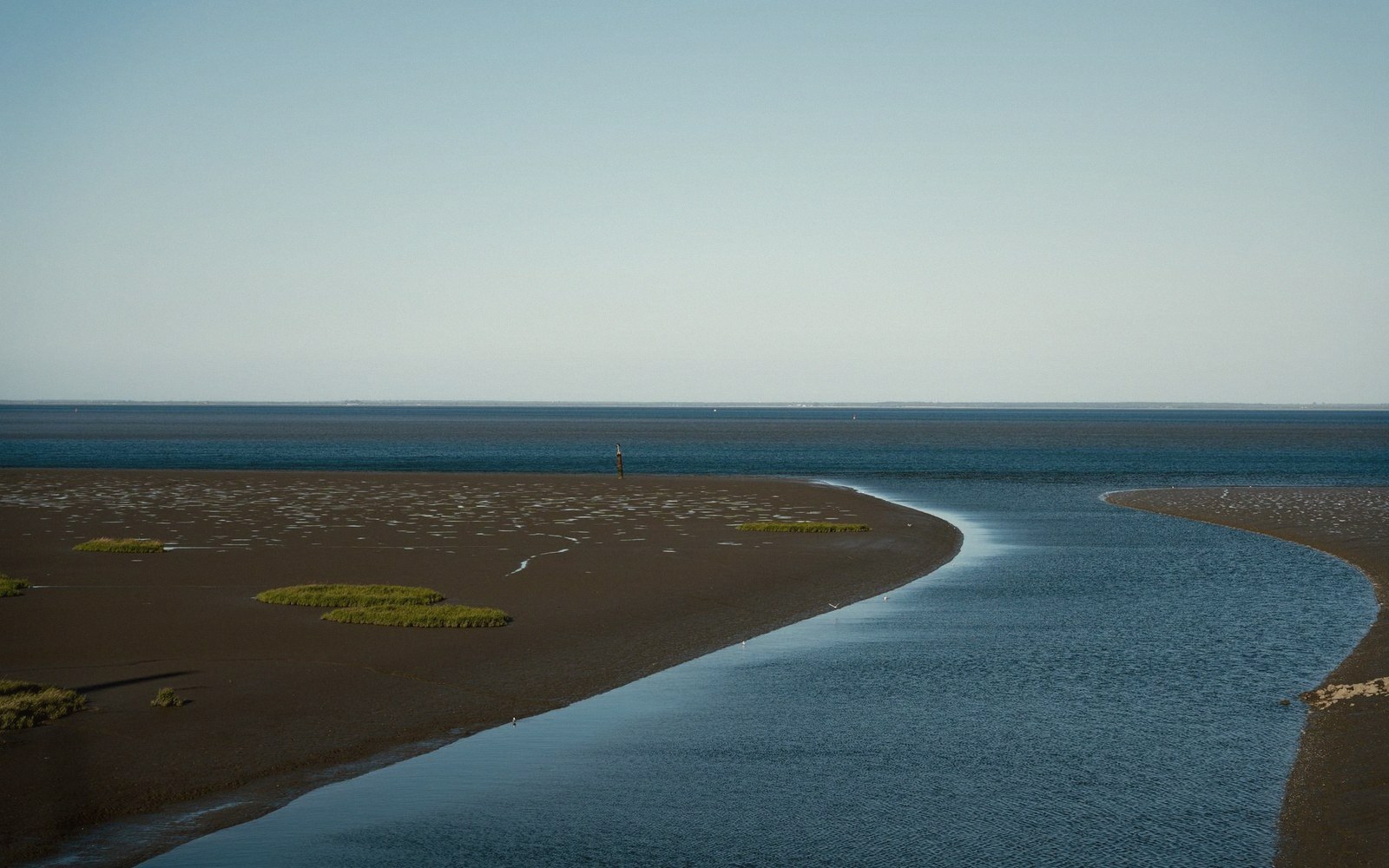
On ordinary tides the Gironde estuary fills and empties in the usual way — water rising for six hours, falling for six, a breathing rhythm that never quite settles because the tidal range here is among the largest on the Atlantic seaboard. But on the biggest spring tides, when the moon is full or new and the atmospheric pressure is low, the incoming flood does something else entirely. It gathers at the mouth of the estuary, is squeezed and accelerated as the channel narrows upstream, and eventually overtakes itself. The result is a single wave, steep-faced and coherent, running upriver against the current: a tidal bore.
The Gironde bore is not the tallest in the world — the Severn Bore in England and the Qiantang in China hold those records — but it is a genuine hydraulic event, not a gentle ripple. On exceptional tides it can reach a metre in height. It moves faster than a person walks, and it arrives with an audible low rumble that precedes it around a bend. Observers on the bank hear it before they see it. The wave runs up the Garonne and the Dordogne both, because the estuary bifurcates at the confluence below Bourg, and the pulse divides and continues into each river, progressively losing energy as the channel shallows and widens again.
The French word for it is mascaret, a term that appears in navigational and meteorological records going back centuries, and which has no exact English equivalent — "tidal bore" is the function, mascaret is the thing as the river knows it.
What makes it here
The geometry of the Gironde creates the conditions. The estuary is wide at the Atlantic mouth, roughly ten kilometres across at the Pointe de Grave, but the effective hydraulic channel is far narrower, and it tapers as it trends southeast. When a large tidal volume — the range at Bordeaux on a coefficient 100 tide can exceed five metres — is driven into a contracting funnel, the wave energy concentrates. The river's own downstream current provides resistance, which is part of what keeps the bore front steep rather than diffuse. Where the Dordogne comes down from the Massif Central carrying its own flow, that resistance is most pronounced and the bore remains distinct furthest upriver.
The tidal coefficient, a French system that runs from roughly 20 to 120, predicts bore formation with reasonable precision. A coefficient below about 95 and the flood simply surges; above it, on the right river conditions and a falling barometric pressure, the wave consolidates. Local pilots, fishermen and the operators of the flat-bottomed river barges that once worked these waters knew the coefficient intimately — a gabarre (a shallow-draft cargo barge built for exactly this estuary) had to be moored or beached before the mascaret arrived, not caught broadside by it.
Stone-carrying boats faced the same arithmetic. The trade that sent limestone blocks downriver to face the quays and façades of Bordeaux depended on timing a departure with the tide, and the bore was a constraint as real as the draft of the loaded vessel. A gabarre that left Bourg too late on a big spring tide did not meet a helpful flood; it met a wall of water moving against every assumption its pilot had made about which way the river was running.
The mascaret is less dramatic now than in historical accounts suggest it once was.
The mascaret is less dramatic now than in historical accounts suggest it once was. Dredging of the navigational channel, which deepened and widened the Garonne approaches to Bordeaux through the twentieth century, dissipated some of the bore's energy by giving the tidal volume more room to spread. The wave still runs. Surfers who time it correctly — and some do, in the lower estuary — can ride it for minutes. But the bore that stopped traffic on the river, the one that warranted paragraphs in pilots' manuals and occasional references in accounts of cargo lost, was more formidable than the wave that runs today.